A practical guide to choosing standard, platform-based customized, or fully custom wall-mounted touch panel hardware for smart home and building automation projects.
For smart home brands, KNX companies, and building automation providers that already have their own software, choosing the right wall-mounted touch panel hardware is an important step in product development.
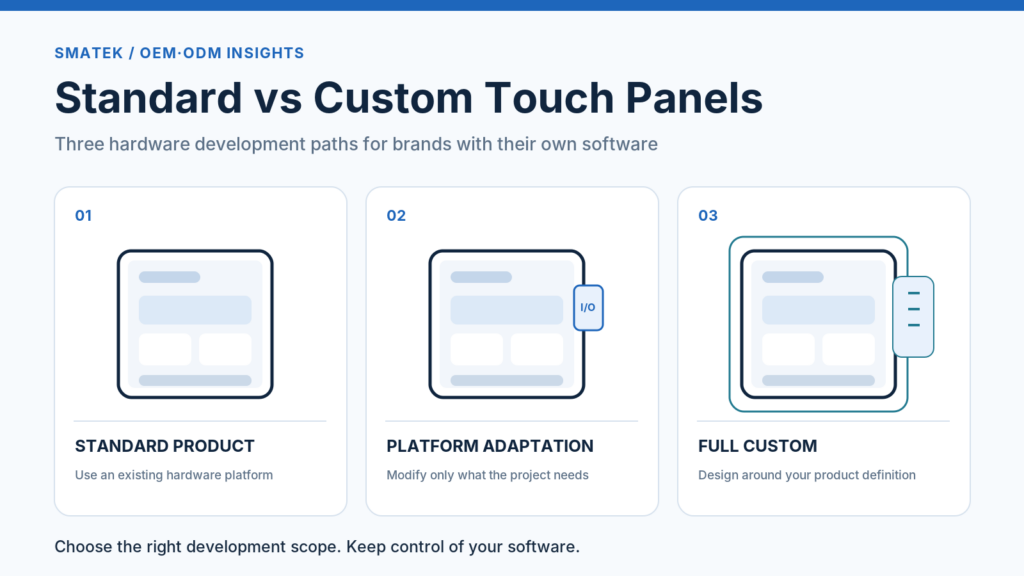
Not every project needs a completely new design. Depending on the hardware requirements, budget, timeline, and expected volume, there are three common approaches.
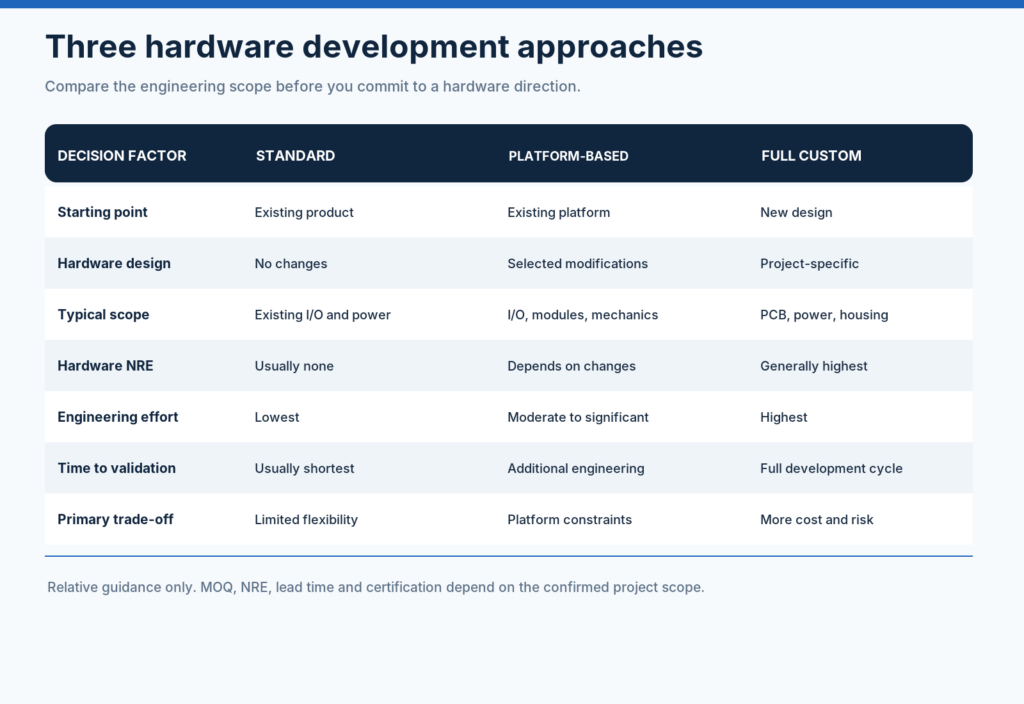
1. Standard Touch Panels: Use an Existing Product
The simplest approach is to select a standard touch panel that already meets the project’s hardware requirements.
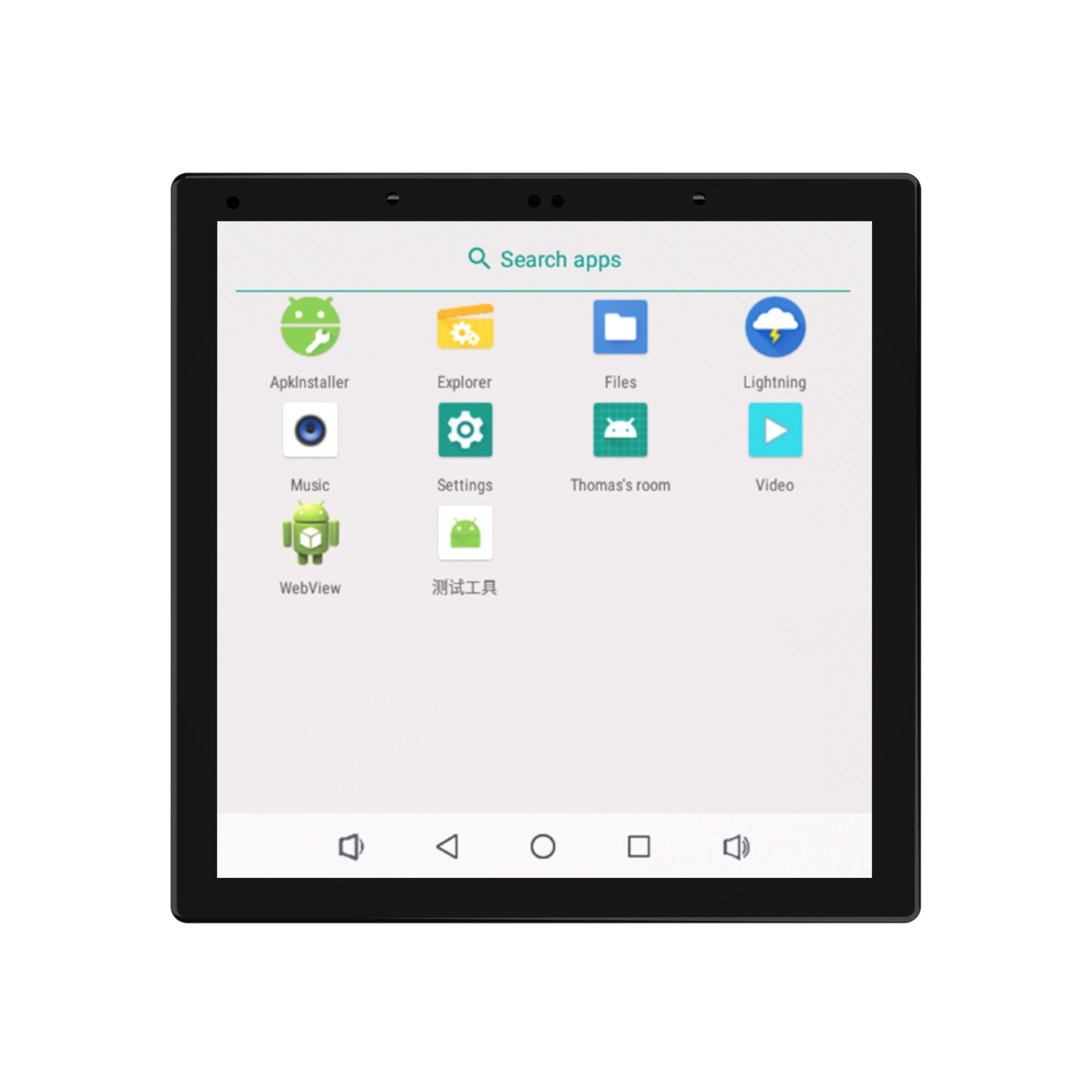
For example, a smart home brand may need a 10-inch Android panel with PoE, Ethernet, and Wi-Fi to run its own application.
If an existing model meets these requirements, there may be no need to modify the hardware.
This approach offers several advantages:
- Faster project evaluation and software integration
- No additional hardware development required
- Lower initial engineering investment
The customer develops its own application and system logic, while the supplier provides the existing hardware platform, base operating system, and relevant technical support.
The main limitation is flexibility. Screen size, processor, interfaces, power supply, and installation structure are defined by the standard product.
2. Platform-Based Customization: Modify What Is Needed
Sometimes a standard product meets most requirements, but certain details need to be changed.
Instead of developing a completely new product, customers can start from an existing hardware platform and customize selected elements.
Depending on the project, modifications may include housing color, mounting structure, memory configuration, communication interfaces, wireless modules, or selected mainboard and power-related changes.
This approach can offer a practical balance between development investment and product differentiation.
However, not all modifications are minor. Changes involving PCB design, power architecture, or mechanical tooling may require additional engineering, validation, and certification evaluation.
3. Full Custom Development: Build Around Your Product
When existing platforms cannot meet the intended product requirements, full OEM/ODM hardware development may be the more suitable option.
In this approach, the customer can provide its own industrial design and hardware specifications, while the supplier develops the corresponding hardware and mechanical solution.
Customization can extend to:
- Industrial design, housing, and materials
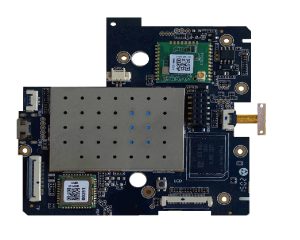
- Mainboard architecture and processor selection
- Power supply and communication interfaces
- Wireless modules, sensors, and additional I/O
- Installation method and mounting structure
This approach offers greater design freedom and product differentiation, but generally involves higher development costs, longer engineering cycles, and project-specific MOQ requirements.
How to Choose the Right Approach
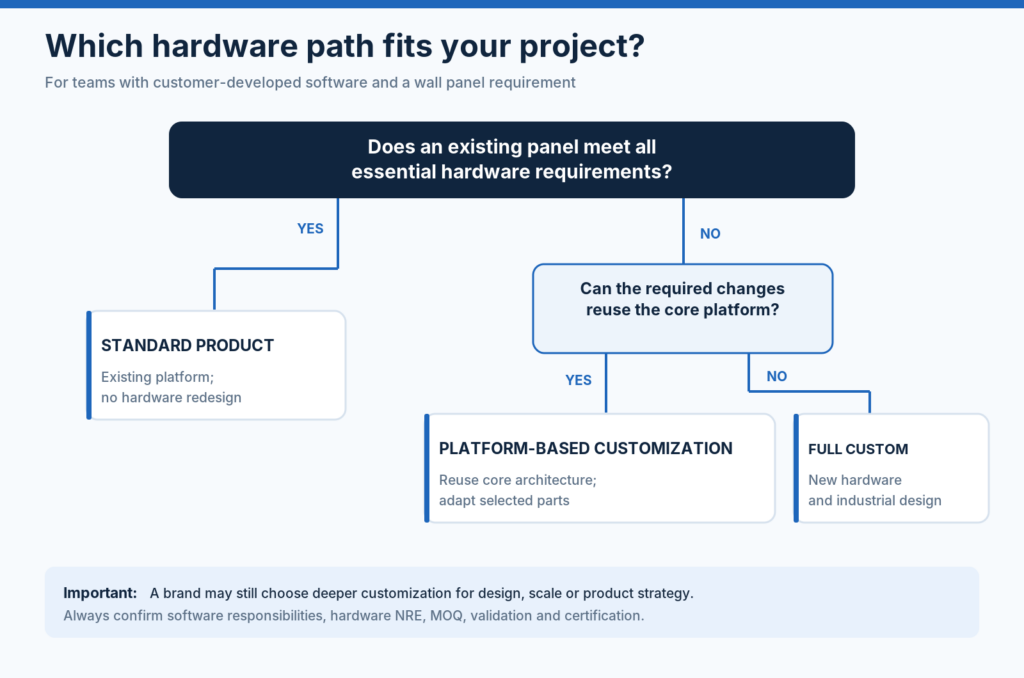
The decision should begin with the product requirements rather than the available customization options.
Choose a standard product when the existing hardware already meets the essential specifications.
Consider platform-based customization when most requirements are covered, but selected hardware or mechanical changes are necessary.
Choose full custom development when the product requires a fundamentally different design, hardware architecture, or installation concept.
Development cost, NRE, MOQ, certification requirements, and expected production volume should also be evaluated before making a decision.
How Smatek Supports These Projects
At Smatek, we support all three approaches for smart home, building automation, hotel automation, HVAC, and other wall-mounted control panel applications.
Our cooperation model focuses on hardware platforms, Android/Linux base systems, interfaces, and OEM/ODM development, while customers typically retain control of their own applications, UI, and system logic.
Depending on the agreed scope, we can also integrate customer-provided applications and configuration files into the production firmware.
For more information, explore our OEM/ODM Control Panel Solutions or read What Can Be Customized in a Touch Panel Hardware Platform?.
Planning a wall-mounted control panel for your own software?
Contact Smatek to discuss your requirements and evaluate the most suitable hardware development approach.