IFA 2026 brought another wave of AI appliances, robots and connected devices to Berlin.
But behind the individual product launches, one development may have a more lasting impact on the architecture of the smart home:
Intelligence is increasingly moving closer to the home itself.
Instead of relying entirely on cloud services, a new generation of local smart home hubs is combining device control, storage, automation and AI processing inside the home.
Two interesting examples presented at IFA 2026 are Anker MindBase and UGREEN HomeAgent.
Both Anker and UGREEN exhibited in the Smart Home area at IFA 2026, while UGREEN HomeAgent HA100 and HA100 Pro and Anker MindBase Security Kit were also recognized as honorees in the IFA 2026 Smart Home Innovation Awards.
The important development, however, is not the box itself.
It is where smart home computing, automation and data processing are beginning to happen.
From Connected Home to Local Intelligent Home
For many years, smart home development focused primarily on connectivity.
Connect the light.
Connect the thermostat.
Connect the camera.
Connect everything to an app or cloud platform.
That model is now beginning to evolve.
As smart home systems incorporate more cameras, sensors, voice interaction, energy management and AI-assisted automation, sending every event to the cloud is not always the most efficient architecture.
Local processing can offer several practical advantages:
- Faster response
- Reduced dependency on internet connectivity
- Greater control over private household data
- Lower cloud processing and storage requirements
- More reliable local automation
This is especially relevant for applications involving video, voice, occupancy, security and other privacy-sensitive information.
The direction can be summarized simply:
Cloud-first → More local processing
Remote intelligence → Edge intelligence
Device control → Context-aware automation
This does not mean cloud services will disappear. In many systems, the more realistic architecture will remain hybrid.
What is changing is that more intelligence can now stay inside the home.
Anker MindBase and UGREEN HomeAgent: Two Signals From IFA 2026
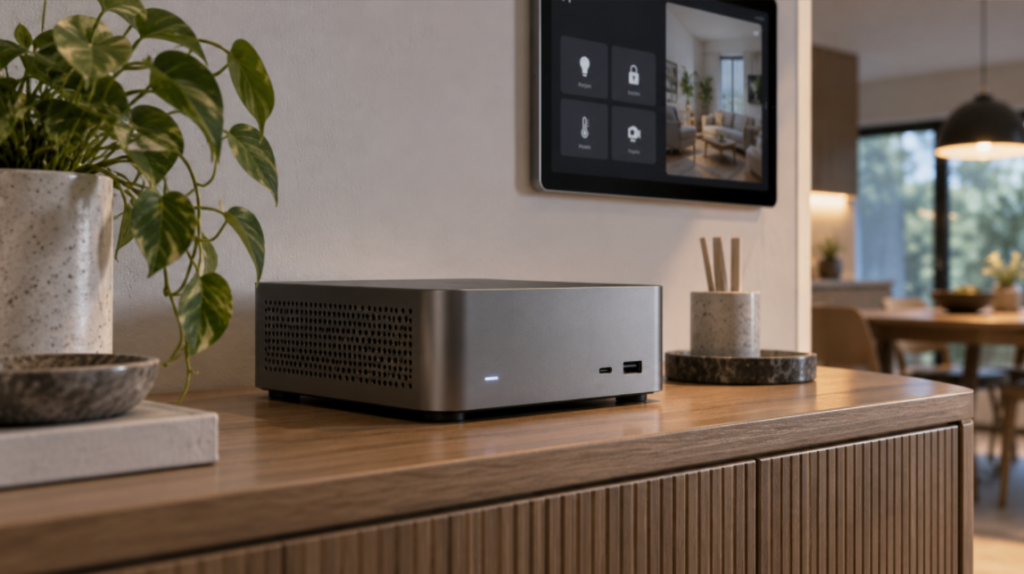
Anker MindBase combines smart home control, local AI processing and expandable local storage.
The system is designed as a Matter controller and can work alongside major smart home ecosystems. It also places a strong emphasis on locally processed security data and supports up to 48TB of expandable storage.
UGREEN takes a similar but slightly different route.
IFA’s own coverage describes HomeAgent as an Agentic AI Local Hub that combines local storage, computing and control in one device. It connects UGREEN and third-party smart home devices while using local AI for applications such as security analysis, natural-language interaction and home automation.
These products come from companies with different backgrounds.
Anker already operates across security, energy, cleaning and other consumer electronics categories.
UGREEN has strong experience in NAS, storage and networking.
Yet both are moving toward a similar architectural idea:
A dedicated local computing node inside the home.
That convergence is worth watching.
Matter Is Expanding What a Local Hub Can Coordinate
Another important part of this trend is the continued expansion of Matter.
Matter is no longer limited mainly to lighting, plugs and basic sensors.
Matter 1.5 added support for cameras and closures while significantly expanding energy-management capabilities, including energy pricing, tariffs, solar generation information and enhanced EV charging functions. Camera support also incorporates WebRTC for audio and video streaming.
This broadens the potential role of a local smart home controller.
A future home platform may increasingly need to coordinate not only:
Lighting and curtains
but also:
HVAC
Security and cameras
Solar and battery storage
EV charging
Energy tariffs
Appliances
and eventually more autonomous home devices.
As interoperability improves, the value of the central platform may move away from simply “supporting another protocol” and toward how well it can coordinate data, automation and user interaction across different systems.
Why Edge Computing Platforms Such as RK3576 Become More Relevant
This development also changes how embedded processors should be evaluated for smart home hardware.
Traditionally, the processor inside a wall-mounted control panel was often selected mainly according to:
display resolution,
UI performance,
Android or Linux requirements,
memory,
and interface requirements.
Those factors remain important.
But local AI and edge processing add another question:
How much computation should happen directly on the device?
Rockchip RK3576 is one example of this transition.
RK3576 combines four Cortex-A72 and four Cortex-A53 CPU cores with an integrated 6 TOPS NPU, supports Android and Linux, and provides interfaces including PCIe, USB 3.0, SATA and dual RGMII Ethernet. Rockchip also positions the platform for visual and voice-recognition applications.
That does not mean every RK3576-based device needs to become an “AI home brain”.
In many smart home and building automation applications, its more realistic value is the ability to support additional local workloads such as:
lightweight AI inference,
sensor processing,
voice processing,
computer vision,
local automation,
and richer edge applications.
In other words, the processor is no longer selected only for how smoothly it can run the interface.
Increasingly, it may also be selected according to what the device can understand and process locally.
Does a Local AI Hub Reduce the Need for Wall-Mounted Control Panels?
At first glance, a more powerful local home hub might appear to compete with the traditional central control panel.
We believe the opposite may happen.
The two products solve different problems.
A local edge hub can become the:
computing layer
automation layer
storage layer
and potentially the:
local AI layer
of the home.
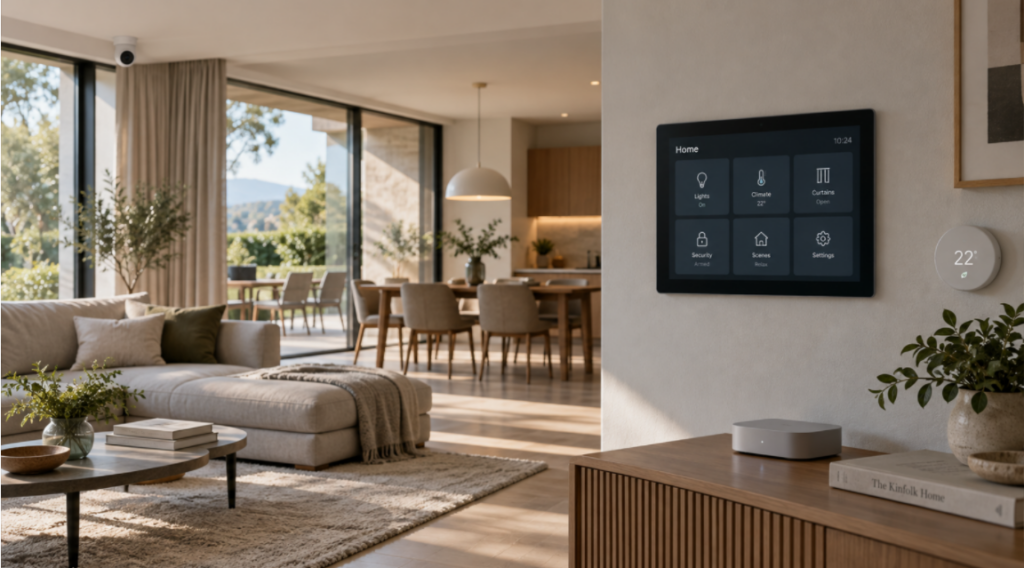
A wall-mounted control panel remains something different:
the persistent human interface to the physical space.
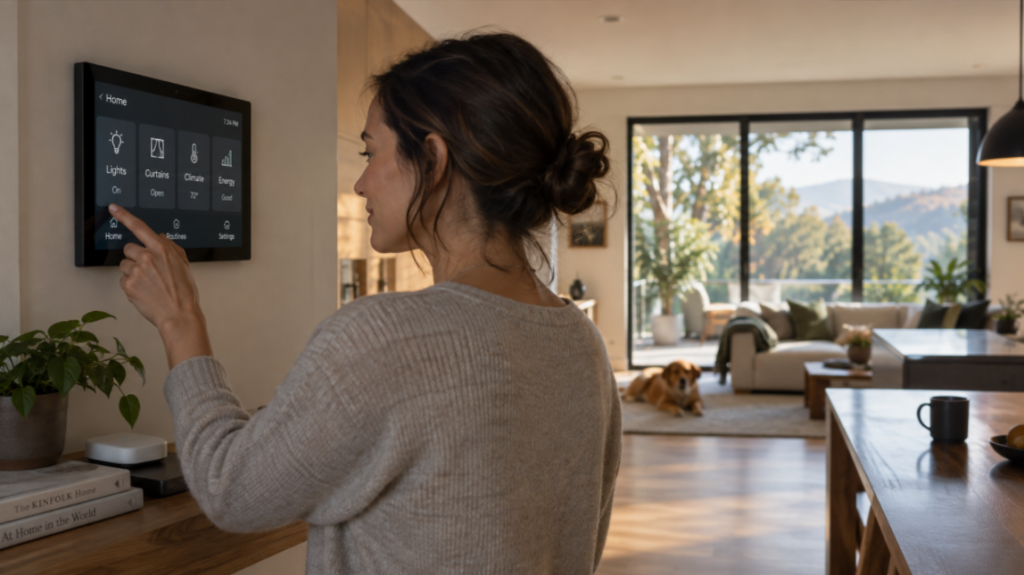
Unlike a smartphone, a wall-mounted interface is always in a known location.
Unlike voice control, it provides visual confirmation.
Unlike a central server, it allows users to directly view and override what the home is doing.
This distinction may become even more important as automation becomes more proactive.
A user still needs a simple way to answer questions such as:
What temperature is the room set to?
Why were the curtains closed?
Who is at the door?
How much energy is the home currently consuming?
What automation has just been triggered?
How can I override it?
The role of the wall panel may therefore evolve from a traditional central controller toward a more permanent human–home interface.
A Possible Architecture for the Next Generation of Smart Homes
Instead of expecting one device to perform every function, future smart home systems may become more distributed.
One possible architecture is:
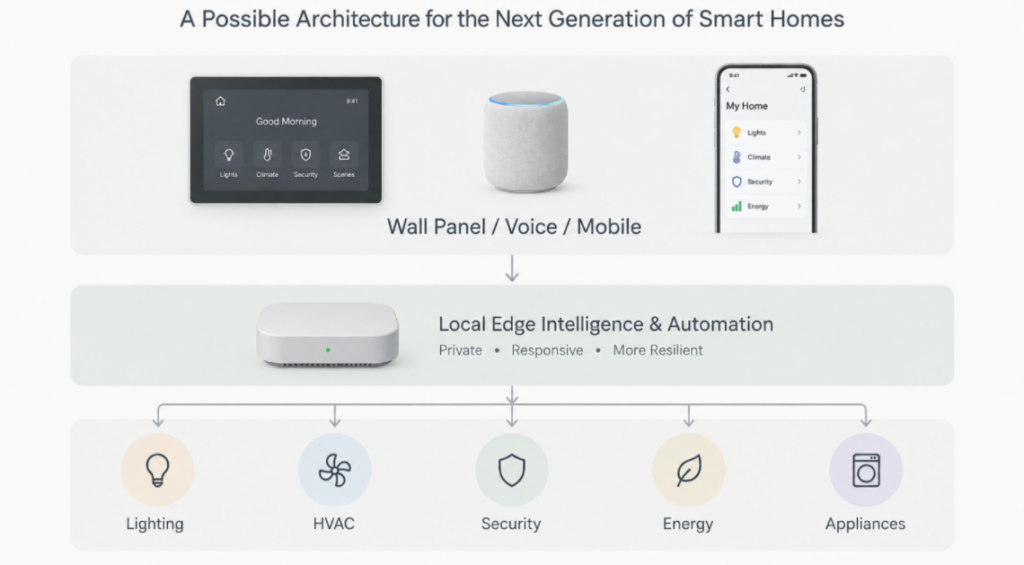
In this architecture:
the wall-mounted panel handles interaction,
the local hub handles heavier computing and automation,
and connected devices execute the actual functions.
Some projects may combine these layers inside one device.
Others may separate them.
The right architecture will depend on the application, system scale, performance requirements, privacy expectations and cost targets.
This is why the next competition in smart home hardware may not only be about:
screen size, RAM, storage or connectivity.
It may increasingly be about:
Where should the intelligence live?
What This Means for Smart Home Hardware Development
For smart home brands, system developers and building automation companies, this trend introduces several new hardware questions.
Should automation continue to depend primarily on the cloud?
Does the project need a dedicated local controller?
Should the wall panel perform some local processing itself?
How much AI capability actually needs to run at the edge?
Should Matter, Thread, Zigbee, KNX, RS485 or other interfaces be integrated directly?
How should local processing interact with HVAC, security, energy and building systems?
There will probably not be one universal answer.
But hardware platforms will increasingly need the flexibility to support different architectures.
At Smatek, we develop Android and Linux hardware platforms for wall-mounted smart home and building automation applications, including platforms based on processors such as RK3576.
Our typical cooperation model allows customers to develop and maintain their own software, UI and system logic, while we support the underlying hardware platform, operating system, interfaces and hardware customization.
As local processing, AI-assisted automation and open connectivity continue to evolve, we are also closely following how these technologies may influence the next generation of wall-mounted interfaces and local edge hardware platforms.
If you are developing a smart home, building automation, HVAC or energy management solution and are evaluating a customized Android/Linux hardware platform, we would be glad to discuss your project requirements.